
Listed on 
 Years active
 English
  Dutch - Nederlands
 French - Français
 German - Deutsch
 Greek - Ελληνικά
 Hungarian - Magyar
 Italian - Italiano
 Polish - Polski
 Spanish - Español

Get in touch
- Home
- Getting Started
- Blog
Years activeGet in touch
iFOREX Europe uses cookies to improve your browsing experience, personalize ads, analyze traffic, and ensure security. For more information, please visit our Cookie Policy or go to Manage preferences.
 25/04/2026 - 01:44 UTC

The week ahead – 27th April 2026
US markets have continued to flirt with record highs this week, after President Trump extended the ceasefire indefinitely in order to allow Iran to come up with a “unified proposal”.
While this has encouraged the idea that both sides are looking to avoid a resumption of outright hostilities, there is still an undercurrent of minor infractions that has seen Iran seize 2 ships trying to cross the Straits of Hormuz in retaliation for US interceptions of Iranian ships under its own blockade of the Strait.
These minor infractions have served to push oil prices back towards their recent highs, and in so doing are complicating the outlook for inflation at a time when central banks are due to meet next week and make their assessments on the outlook for their respective economies.
Bond markets are once again pricing in the prospect of possible rate hikes over the course of the next few months, with gold prices also slipping back in anticipation of higher rates.
With concerns about inflation persistence very much front and centre and uncertainty increasing about how central banks are likely to react we’ve got policy announcements from the Federal Reserve, the European Central Bank and the Bank of England.
It’s also set to be another big week for earnings, with 5 of the Magnificent 7 US tech giants set to report in the form of Alphabet, Amazon, Apple, Meta and Microsoft.
Here’s my overviews of the Federal Reserve, as well as the Fab 5 US tech giants
Having sat through the testimony of new Fed chair nominee Kevin Warsh it seems clear that there probably won’t be wholesale change at the Federal Reserve this summer. While some Democrats sought to paint him as a sock-puppet for the President it's quite likely he will prove to be his own man, raising the question as to why President Trump nominated him. Warsh was at pains to say that interest rates would be his central focus, along with the balance sheet, while he went on to say that there ought to be less Fed speak. We also learnt that he would be looking to get rid of the dot plots, which while a talking point for a lot of people were as much use as a chocolate teapot.
So, what to expect at the latest meeting?
It’s likely to be a case of steady as she goes with the labour market still looking resilient despite a sharp increase in inflation, driven primarily by gasoline prices. The FOMCs biggest concern is likely to be around second round effects in the form of higher wages, along with higher prices for staples as well as consumer discretionary items. This almost seems inevitable given that the Straits of Hormuz remains closed and the effects of that disruption is yet to be felt in most global supply chains.
When Google owner Alphabet reported its Q4 numbers at the beginning of February, the shares plunged sharply, albeit from record highs. Even allowing for the fact that there have been increasing concerns about escalating spending on AI infrastructure, the Alphabet share price had stood out of late up until then, the shares more than doubling from the “liberation day” lows of $139 of April 2025.
For Q4 the company comfortably beat expectations across the board, revenues rising 18% to $113.83bn, pushing annual revenues up to a staggering $402.8bn, an increase of 15%.
Net income for Q4 increased to $34.4bn, while on an annual basis this rose to $132.17bn, an increase of 32%. The share price slide in the aftermath of the numbers came about from the announcement that they intend to increase their AI spend from the $92bn they announced in Q3 to as high as $175bn to $185bn in the fiscal year 2026.
This was way above market consensus which was $119bn. Management said that search revenue, which beat market expectations, was being driven increasingly by AI and Gemini with over 750m active users. The company saw growth across all of its business areas. Q4 advertising saw revenues surge 13% to $82.28bn, with search seeing revenues rise by $9bn to $63bn. YouTube also saw revenues increase, rising by $900m to $11.38bn.
The cloud business stood out however with revenues there seeing an increase of almost 50% to $17.66bn. This growth in its cloud business may well be what’s driven Alphabet to up spending in order to build out its AI infrastructure, and while the amount being spent is indeed high, it’s not as if Alphabet can’t afford it, funding it from their existing cashflow at the time, although since then they have gone on to announce a multi-currency bond structure, worth over $30bn, including a 100-year century bond, which attracted over $100bn in orders. In the period since that announcement, the shares have recovered that lost ground after rebounding from their 200-day SMA.
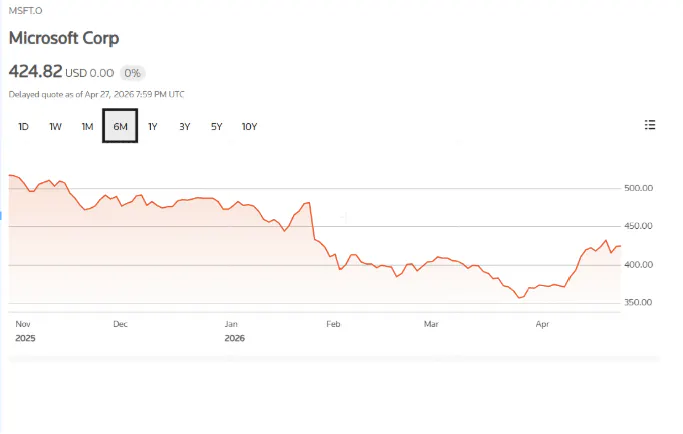
One of the worst performing tech stocks since the shares hit a record high back in the middle of last year, sliding from $566 before finding a base in March at $355.
Most of this was due to concern over the company’s exposure to OpenAI with 40% of its order backlogs contingent on its deal with OpenAI, where there is some doubt as to the ability of the latter to be able to pay for all of this work.
Q2 revenues came in at $81.27bn, an increase of 17%, topping estimates across the board, and well above the $69.63bn a year ago. Annual revenues came in at $158.5bn, up from $135.2bn in 2025. Cloud revenue drove most of that gain rising to $51.5bn, compared to $40.9bn a year ago. Intelligent cloud which includes the Azure business also performed well bringing in $32.9bn, an increase of 29% and also beating forecasts.
That said total costs also increased, rising to $50bn for the year, an increase of almost 20%. Capex for Q2 also saw a sharp increase, rising to $37.5bn, up from the $22.6bn in the same quarter last year, with the company saying it needed to do this to address these backlogs. All of the MS businesses performed reasonably well, with the notable exception of Xbox content and services where revenue declined 5%.
On guidance for Q3 Microsoft said it expects to deliver $80.65bn-$81.75bn in revenue, with growth in its Azure business projected at around 37% which was in line with consensus.
When Meta reported at the end of January the shares surged sharply after posting an impressive set of Q4 numbers. While those gains proved to be somewhat short-lived with the shares sliding sharply through February and March to a 10-month low of $518, we have seen a modest recovery since then, along with the rest of the tech sector.
Q4 revenue came in above the upper end of guidance at $59.9bn, a 24% increase pushing total revenue for the year up by 22% to $200.96bn, while net income rose to $24.74bn. Total costs for the year came in line with forecasts at $117.6bn, a rise of 24%. While net income for Q4 came in 9% above the same quarter a year ago at $22.77bn, this wasn’t enough to prevent a 3% decline in annual net income to $60.46bn. Total capex for 2025 came in at $72.22bn.
Breaking down the numbers, the Family of Apps operation delivered $58.9bn in revenue for Q4 and $198.76bn in annual revenue, as well as delivering total income from operations of $30.76bn and $102.47bn respectively.
Reality Labs delivered $955m of revenue in Q4, and $2.2bn in annual revenue, as well as losses of $6bn and $19.2bn respectively.
For Q1 26 Meta says it expects to see revenue to be in the range of between $53.5bn and $56.5bn, while total expenses are expected to be in the region of between $162-169bn, which will include higher infrastructure operating expenses and cloud spend. Capex spend will also increase to between $115-135bn.
Of all the Magnificent 7 Apples shares had until recently lagged somewhat largely down to the fact that as far as AI is concerned, they were well off the 8 ball, and unlikely to catch up.
The shares have also struggled since their December 2025 peaks despite a bumper set of Q1 results. Nonetheless they do appear to have solved this issue by signing a deal with Alphabet to use Gemini to augment Siri, thus contracting out their AI problem to a third party. This may well prove to be a smart move and could well pay off, however it also puts them at the mercy of someone else’s development timetable.
Nonetheless Apple’s Q1 results always tend to be a decent quarter, covering as it does the Thanksgiving and Christmas period and this year was no different. Q1 revenue rose 16% to $143.8bn, while profits came in at $2.84c a share, or $42.1bn. The sale of its new iPhone along with services, drove this revenue surge as sales of the iPhone surged to $85.27bn, blowing through upper expectations, and well above the $69.14bn a year ago. The company reported growth in all its regions with Greater China seeing a large jump in sales to $25.5bn from $18.5bn a year ago. Mac sales were disappointing, slipping to $8.39bn from $8.99bn a year ago, while wearable sales also slowed. iPad sales on the other hand saw growth to $8.6bn, while services revenue jumped 14% to $30bn from $26.34bn.
What was all the more surprising is that the concerns about tariffs slowing down sales seem somewhat overblown. With the shares largely trading sideways this quarter it will be interesting to see what Apple has to say about the recent disruption to supply chains in the Straits of Hormuz and the impact on chipset costs.
It will also be interesting to see how the news that Tim Cook is stepping down as CEO to be replaced by head of hardware John Ternus will affect the way the company is run.
How should Cook be judged?
It is true that Apple is a cash machine, but innovation has slowed Apple Watch, AirPods and Vision Pro are notable, while Apple Music services growth has done well, along with sales of its core products.
What comes next though? – Apple missed the boat on AI and it’s not immediately apparent what the next big thing is. Ternus will take over in September and oversee the first folding iPhone, along with an updated Siri.
Google owner Alphabet set the bar at the start of February when they announced that they would be upping the ante hugely when it came to spending on its AI infrastructure build out plans by doubling its capex spend in this area.
Rather than set a more cautious tone, Amazon did the equivalent of saying “hold my beer” and committed to spend $200bn in their new fiscal year as it looks to stay ahead in the AI build out race, prompting the shares to fall sharply to their lowest levels since May last year, as concerns about the AI arms race raised more and more questions about returns.
That share price slumped proved to be more or less the bottom with the shares recovering all of those losses in the last few days. In Amazon’s case the market clearly believes they can afford it, and the numbers would appear to suggest that.
In Q4 Amazon saw net sales increase 14% to $213.4bn, with North America seeing a 10% YoY gain, while international sales rose 17%. AWS also saw 24% YoY sales growth to $35.6bn. Net income increased to $21.2bn during the quarter.
For the full year, total revenues were up by 17% to $716.9bn while net income increased to $77.7bn, compared to $59.5bn in 2024.
Over the year AWS saw its fastest growth in 13 quarters, helped by AI agreements with OpenAI, Visa, BlackRock, Lyft, United Airlines and HSBC to name but a few. Free cash flow was sharply lower at $11.2bn, compared to $38.2bn in 2024, largely due to significant year over year increases in the purchases of property and equipment due to investments in AI.
For Q1 Amazon says it expects net sales of between $173.5bn and $175.5bn, with operating income expected to be in line with Q1 last year at around $19bn, below expectations of $22bn.
The materials contained on this document should not in any way be construed, either explicitly or implicitly, directly or indirectly, as investment advice, recommendation or suggestion of an investment strategy with respect to a financial instrument, in any manner whatsoever. Any indication of past performance or simulated past performance included in this document is not a reliable indicator of future results. For the full disclaimer click here.
 Trusted partner
 Featured partner
 By
By 


