
Listed on 
 Years active
 English
  Dutch - Nederlands
 French - Français
 German - Deutsch
 Greek - Ελληνικά
 Hungarian - Magyar
 Italian - Italiano
 Polish - Polski
 Spanish - Español

Get in touch
- Home
- Getting Started
- Blog
Years activeGet in touch
iFOREX Europe uses cookies to improve your browsing experience, personalize ads, analyze traffic, and ensure security. For more information, please visit our Cookie Policy or go to Manage preferences.
 26/05/2026 - 07:20 UTC
The USDX eased slightly, losing -0.06% on Monday to trade around 99.10 heading into Tuesday's Asian session. Despite the marginal dip, the Greenback maintained its broader fundamental footing as a flare-up in Middle East tensions triggered renewed safe-haven demand. Tensions escalated following reports that U.S. forces conducted self-defense strikes against missile launch sites and mine-deploying vessels in southern Iran. While Bloomberg reported that U.S. President Donald Trump described negotiations as "proceeding nicely," he explicitly warned that a collapse in talks could trigger fresh military attacks. Supporting the underlying strength of the asset, market participants continue to reprice monetary policy expectations, with the CME FedWatch tool now indicating a nearly 41.0% probability of a 25-basis-point Federal Reserve rate hike by the end of the year to combat persistent consumer inflation.
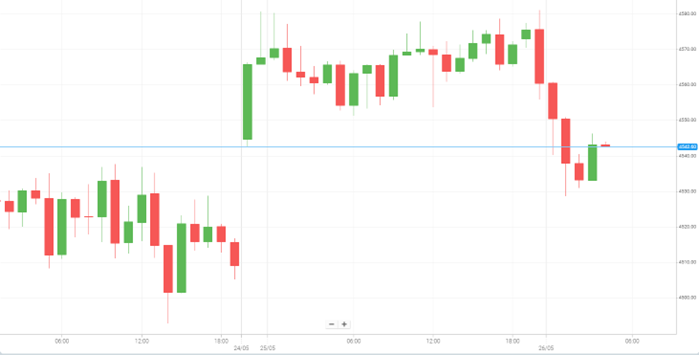
Gold fell -0.16% on Monday, remaining vulnerable under the $4,580 as it attracted fresh selling pressure heading into Tuesday. The non-yielding precious metal faced headwinds as the revival of safe-haven demand for the U.S. Dollar took precedence. Mixed geopolitical signals—highlighted by the tactical military friction in southern Iran amid unresolved issues regarding Tehran's nuclear program—have successfully sustained the geopolitical risk premium. This friction, alongside aggressive bets that the Federal Reserve will implement at least one additional interest rate hike by the end of the year, continues to drive capital flows away from bullion and capped its recent recovery attempts. Investors are now positioning ahead of key U.S. economic data slated for Thursday, including the preliminary GDP report and the Core PCE Price Index, to gauge the asset's next directional move.
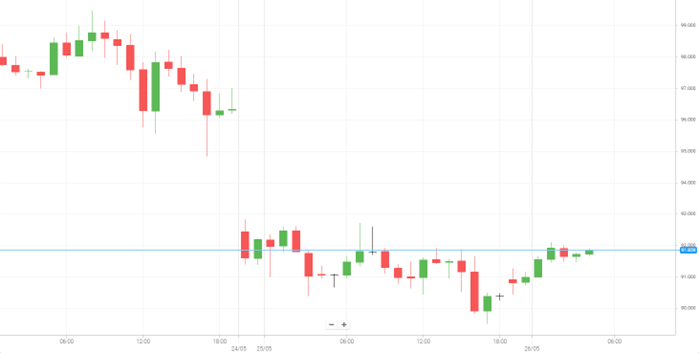
WTI Oil dropped -1.30% on Monday, initially sliding over 6% during the session before mounting a partial late-day recovery to trade near $90.60 per barrel by Tuesday's Asian hours. Energy benchmarks faced severe downward pressure after President Trump noted that a memorandum of understanding to extend the ceasefire by 60 days and reopen the Strait of Hormuz was advancing smoothly. Optimism was validated by ship-tracking data showing that three LNG tankers and a previously stranded Iraqi crude supertanker successfully crossed the critical waterway. However, the full extent of the drop was firmly reversed after U.S. Central Command confirmed that American forces had launched self-defense strikes in southern Iran against naval mine units. This renewed threat to the maritime corridor reignited immediate supply disruption anxieties, helping crude prices bounce off their two-week lows as traders weighed the fragile nature of the ongoing truce.
Most regional indices edged slightly lower on Tuesday as fresh U.S. military strikes in Iran tempered optimism over a potential Middle East peace deal, though technology shares demonstrated notable underlying resilience following positive leads from Wall Street late last week. This cautious tone prevailed despite a modest uptick in U.S. stock index futures during Asian hours following Monday's holiday closure, as investors carefully weighed regional developments alongside a heavy slate of upcoming global macroeconomic data.
In regional developments, mainland Chinese benchmarks moved lower amid fragile investor sentiment following the defensive U.S. strikes on missile launch sites and vessels in southern Iran. The China SSE slipped during the session, while the Hong Kong 50 bucked the downward trend to climb higher. The advance in Hong Kong was heavily supported by a dramatic catch-up rally in semiconductor shares after a major domestic chip design breakthrough boosted optimism over regional supply chain self-reliance. Concurrently, equity benchmarks in Tokyo experienced a minor pullback following their historic climb to all-time highs in the previous session. The Nikkei 225 and the broader TOPIX both edged lower as market participants locked in profits from the recent chip-led rally.
On the corporate front, despite a slight pause in broader global chip momentum during the latest U.S. trading session—where Nvidia shares dipped -1.91% on profit-taking—South Korean tech heavyweights experienced a massive surge. Returning from a Monday holiday, the local benchmark vaulted to a record high, spearheaded by SK Hynix, which surged 6.71%. Sector giant Samsung Electronics also climbed 2.39% as intense enthusiasm surrounding artificial intelligence infrastructure and memory demand dominated trading.
The broader macroeconomic environment saw oil prices rebound as supply disruption fears resurfaced following the military action near the Strait of Hormuz, directly keeping inflation anxieties in play. This volatile energy backdrop precedes a critical latter half of the week, where market focus is set to pivot to the U.S. Core PCE Price Index—expected to hold steady at 0.3% month-over-year—and the Preliminary GDP print, forecasted to jump to 2.1%. These prints, alongside an upcoming speech from Bank of England Governor Andrew Bailey and key software earnings from Salesforce, Dell, and Zscaler, will serve as the next major catalysts for global interest rate and spending expectations.
The euro edged lower against the US dollar during Tuesday’s early Asian trading session, with EUR/USD slipping toward 1.1635 as uncertainty surrounding a potential US-Iran peace agreement increased demand for safe-haven assets. Investors are also awaiting remarks later in the day from European Central Bank policymaker Olaf Sleijpen and Minneapolis Federal Reserve President Neel Kashkari.
Market sentiment turned cautious after reports that US forces carried out defensive strikes in southern Iran on Monday. According to Fox News, the operations targeted missile launch sites and Iranian vessels allegedly attempting to deploy naval mines. A spokesperson for US Central Command said the military would continue protecting its personnel while maintaining restraint under the current ceasefire conditions.
Earlier in the week, US President Donald Trump stated that negotiations aimed at ending the conflict with Iran and reopening the Strait of Hormuz were “progressing well,” according to Bloomberg.
Despite the pair’s downside pressure, expectations of tighter monetary policy from the European Central Bank may help support the euro. ECB Governing Council member Martin Kocher said on Sunday that policymakers are increasingly considering an interest rate increase next month as geopolitical tensions linked to Iran continue to add inflationary pressure.
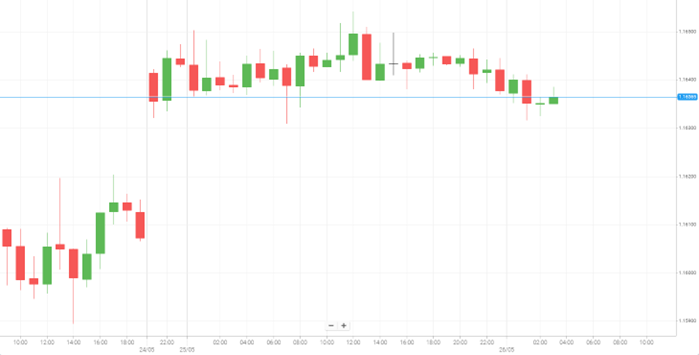
Gold prices moved lower during Tuesday’s Asian trading session, surrendering much of the previous day’s gains as renewed strength in the US dollar weighed on the precious metal. Gold prices faced selling pressure while ongoing uncertainty surrounding a potential US-Iran peace agreement continued to support demand for safe-haven assets and sustain volatility across global markets.
The US dollar found fresh support amid rising expectations that the Federal Reserve could maintain a hawkish policy stance for longer. Geopolitical tensions in the Middle East, combined with a rebound in crude oil prices, have revived concerns over persistent inflationary pressures, reducing the appeal of non-yielding assets such as gold.
According to reports citing US Central Command, American forces carried out defensive strikes in southern Iran on Monday, targeting missile launch sites and Iranian vessels allegedly attempting to deploy naval mines. The latest military activity comes amid ongoing disagreements over Iran’s nuclear program and continued tensions surrounding the Strait of Hormuz, limiting optimism over a broader peace agreement.
The inflation outlook has strengthened expectations that major central banks, including the Federal Reserve, may keep interest rates elevated for longer. Market participants are increasingly pricing in the possibility of at least one additional US rate hike in 2026, according to the CME FedWatch Tool, a factor that continues to underpin the dollar and reduce investor appetite for gold.
Investors are now turning their attention to upcoming US economic data releases, including the Personal Consumption Expenditures (PCE) Price Index and the second estimate of US GDP, both scheduled for Thursday.
Oil prices advanced during early Asian trading on Tuesday after reports emerged that the United States had launched new strikes against targets in Iran, overshadowing earlier optimism that a breakthrough agreement to reopen the Strait of Hormuz was nearing completion.
Investor sentiment shifted after reports indicated that US forces conducted fresh military strikes in southern Iran late Monday, targeting missile launch sites and vessels allegedly involved in laying naval mines. US officials described the operations as defensive actions and stated that the existing ceasefire arrangement with Iran remained in effect.
Markets are closely watching Tehran’s response, as renewed military activity could complicate ongoing diplomatic efforts between Washington and Tehran. Iran has repeatedly warned against further US attacks, and analysts believe any escalation could threaten prospects for a broader agreement aimed at ending the conflict and restoring stability to shipping routes through the Strait of Hormuz.
US President Donald Trump stated on Monday that discussions with Iran were making progress and claimed Tehran could eventually surrender its stockpile of enriched uranium. Iranian officials, however, have continued to reject suggestions that they would fully relinquish their uranium reserves, although reports indicate the country may be open to future negotiations regarding its nuclear program.
The Strait of Hormuz remains a focal point for global energy markets, as it handles a significant share of the world’s oil shipments. Any disruption to the waterway or escalation in regional tensions is likely to keep volatility elevated across crude markets in the near term.
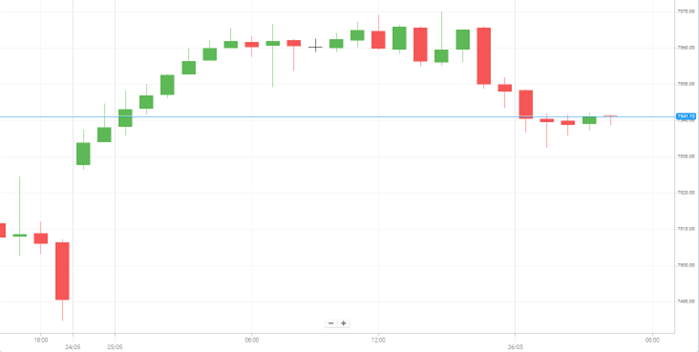
US stock futures moved higher on Monday night as renewed optimism surrounding potential peace negotiations between the United States and Iran boosted investor sentiment and triggered a sharp decline in oil prices.
Markets reacted positively after US President Donald Trump said negotiations with Iran were “proceeding nicely.” Over the weekend, Trump stated that Washington and Tehran had largely negotiated a memorandum of understanding that could eventually lead to the reopening of the Strait of Hormuz, a critical route for global oil and liquefied natural gas shipments. However, he noted there was “no rush” to finalize a deal.
Despite the positive market reaction, gains in US futures were partially limited after reports emerged that American forces carried out fresh strikes in southern Iran on Monday. According to reports, the operations targeted missile launch sites and vessels allegedly involved in laying naval mines. US officials described the attacks as defensive actions and maintained that the ceasefire with Iran remained intact.
Wall Street had ended the previous week on a mixed note before Monday’s holiday closure. The US 30 reached another record closing high on Friday, while broader market sentiment remained sensitive to elevated Treasury yields and uncertainty surrounding the Federal Reserve’s future interest-rate policy.
Attention now turns to upcoming US economic data releases later this week, particularly the Personal Consumption Expenditures (PCE) Price Index, the Federal Reserve’s preferred measure of inflation. Investors will closely monitor the data for further clues on the central bank’s policy outlook and the potential direction of interest rates.
The materials contained on this document should not in any way be construed, either explicitly or implicitly, directly or indirectly, as investment advice, recommendation or suggestion of an investment strategy with respect to a financial instrument, in any manner whatsoever. Any indication of past performance or simulated past performance included in this document is not a reliable indicator of future results. For the full disclaimer click here.
 Trusted partner
 Featured partner
 By
By 


