
 English
  Dutch - Nederlands
 French - Français
 German - Deutsch
 Greek - Ελληνικά
 Hungarian - Magyar
 Italian - Italiano
 Polish - Polski
 Spanish - Español


Get in touch
- Home
- Getting Started
- Blog
Get in touch
iFOREX Europe uses cookies to improve your browsing experience, personalize ads, analyze traffic, and ensure security. For more information, please visit our Cookie Policy or go to Manage preferences.
 05/02/2026 - 08:30 UTC
The USDX strengthened for its second consecutive session, moving 0.27% up on Wednesday and trading near 97.80 during Thursday’s Asian hours. This upward momentum is fueled by hawkish signals from Federal Reserve officials and shifting expectations toward a more measured pace of rate cuts. Specifically, Fed Governor Lisa Cook indicated she would not support further easing without concrete evidence of cooling inflation, prioritizing disinflation over labor market concerns.
Market sentiment is also being shaped by the implications of Kevin Warsh’s nomination as the next Fed Chair. While Warsh is known for favoring a smaller balance sheet and a disciplined approach to rate reductions, President Donald Trump clarified that his nomination was based on the expectation of lower rates, given the current "way high" interest levels. On the data front, the USDX found modest support from a robust ISM Services PMI of 53.8, which helped offset a significantly weak ADP private-sector employment report of only 22K new jobs—well below the 48K forecasted.
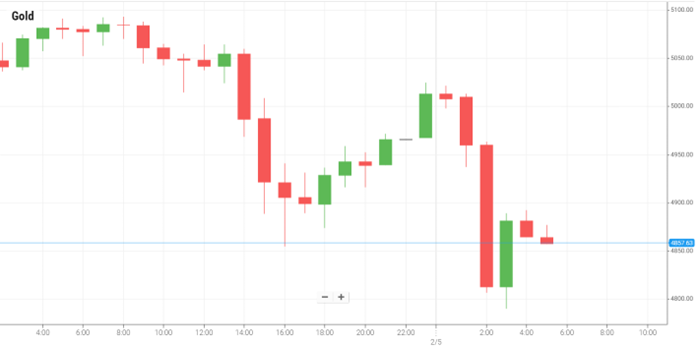
Gold prices experienced a volatile transition; while the metal moved 1.31% up on Wednesday to test the $5,100 level, it faced heavy selling during the early Asian session on Thursday, diving below $4,800. This reversal was triggered by the recovery of the USDX to a two-week high and news that China’s gold consumption fell 3.57% in 2025. Furthermore, reports that the US and Iran have agreed to hold talks in Oman on Friday have eased immediate geopolitical fears, dampening the demand for safe-haven assets.
Asian stock markets retreated on Thursday, pulling back from the record highs established earlier in the week. The decline was primarily driven by volatility in global technology shares as concerns regarding AI-driven disruptions weighed on investor sentiment. This regional softening followed a session where the main US equity indices moved lower, particularly within the tech-heavy Nasdaq.In China, indices faced downward pressure as investors engaged in profit-taking following the recent rally. As of 05:52 AM GMT, the China SSE moved -0.57% lower, while the China SZSE dropped -1.24%. The Hong Kong 50 also trended downward, posting a decline of -0.51% during the same period.The Japan 225 fell -0.85% by 05:52 AM GMT, tracking the overnight weakness on Wall Street. Despite the broader index decline, the Japanese market saw significant resilience in non-tech sectors and specific corporate stories. Meanwhile, in Australia, the benchmark index moved lower as trade data revealed a narrower-than-expected surplus, highlighting uneven global demand.
Individual stocks saw sharp divergent moves based on recent earnings and strategic announcements with Samsung and SK Hynix experiencing significant selling pressure, falling -5.44% and -6.10% respectively, as investors locked in profits following their record-breaking surges earlier in the week. Conversely, Renesas jumped 6.97% up following the announcement of a $3 billion deal to sell its timing business to SiTime. Panasonic also performed strongly, surging 8.05% up after delivering robust earnings and optimistic forward guidance.
In the cryptocurrency market, Bitcoin faced intense selling pressure on Thursday, slumping nearly 8% to hit lows near the $70,000 level. This sharp downturn followed a 3.34% decline on Wednesday, as thinning liquidity and a broad rotation out of global technology stocks weighed heavily on risk assets. By early Thursday, the world’s largest cryptocurrency was trading around $70,427, marking its lowest point since early November 2024. The recent volatility has seen Bitcoin decline in seven of the last eight trading sessions, representing a staggering 40% correction from its record peak near $126,000 notched in October.
For now, traders are closely monitoring the market dynamics ahead of today’s release of the JOLTS Job Openings and weekly Initial Jobless Claims, which will likely provide the next short-term catalyst for investors.
The Euro weakened on Wednesday, slipping more than 0.10% against the US Dollar as the Greenback rebounded from Tuesday’s losses. Robust US services sector data supported the Dollar, while a softer-than-expected inflation print in the Eurozone reinforced expectations that the European Central Bank (ECB) may need to ease policy.
US economic data showed continued strength in business activity. The Institute for Supply Management (ISM) Services Purchasing Managers’ Index (PMI) exceeded expectations, pointing to solid momentum in the services sector despite signs of rising input costs. However, labor market data were more mixed, with private payroll growth undershooting forecasts, suggesting some emerging softness in employment conditions.
The partial US government shutdown has delayed the release of several key labor market indicators. The Job Openings and Labor Turnover Survey (JOLTS) report has been postponed to February 5, while Nonfarm Payrolls are now scheduled for February 11. The Consumer Price Index (CPI) release has also been pushed back to February 13.
Across the Atlantic, Eurozone inflation data surprised to the downside. The January Harmonized Index of Consumer Prices (HICP) rose 1.7% year over year, below expectations, while core inflation eased to 2.2%. The softer inflation backdrop has increased market confidence that the ECB’s next policy move is more likely to be a rate cut rather than a hike.
Attention now turns to the ECB’s policy decision and President Christine Lagarde’s press conference. Investors will be listening closely for any guidance on the outlook for interest rates, as well as commentary on the Euro’s strength, which has recently been influenced by broader US Dollar weakness.
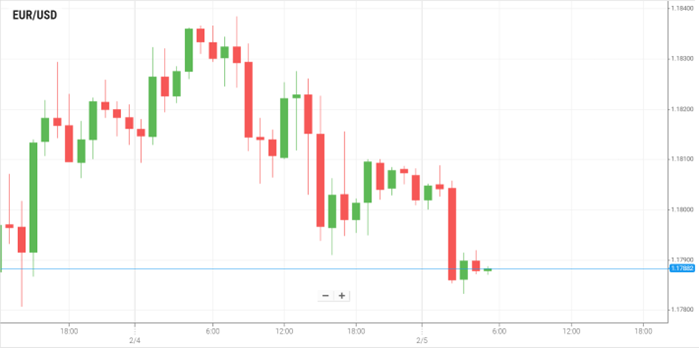
Gold prices came under pressure during the Asian session on Thursday, retreating below the $4,800 level after failing to sustain momentum above the $5,100 area overnight. The pullback was driven largely by renewed strength in the US Dollar, which climbed to a two-week high and extended its recovery from a recent four-year low, weighing on the non-yielding metal.
Adding to the downside pressure, a state-backed Chinese industry body reported a decline in gold consumption in 2025, reinforcing the bearish intraday tone.
Despite the firmer Dollar, losses in gold have remained contained, as expectations for Federal Reserve rate cuts and lingering geopolitical risks continue to underpin demand for safe-haven assets. A softer-than-expected US ADP employment report released on Wednesday highlighted signs of labor market cooling, strengthening the case for further monetary easing by the Fed later this year.
On the geopolitical front, easing tensions between the United States and Iran have slightly reduced safe-haven demand. The two sides have agreed to hold talks in Oman on Friday, alleviating immediate concerns over a broader military conflict. Still, disagreements remain over the scope of negotiations, particularly regarding Iran’s missile program, which could continue to support gold prices if tensions resurface.
Looking ahead, market participants are turning their attention to upcoming US labor market data, including the delayed JOLTS Job Openings report and weekly Initial Jobless Claims. These releases, along with commentary from Federal Reserve officials, are expected to provide fresh direction for the US Dollar and gold prices.
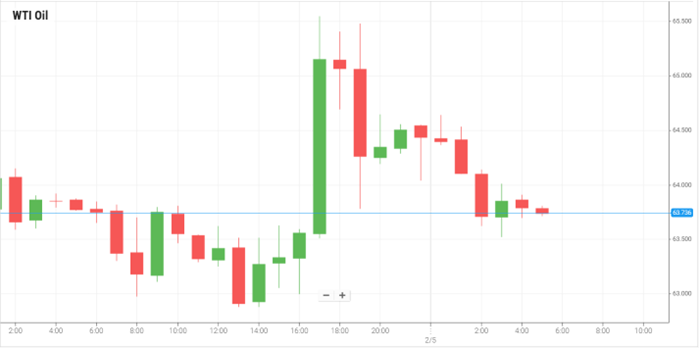
Oil prices fell early on Thursday after the United States and Iran confirmed they would hold talks in Oman on Friday, easing concerns that a potential military confrontation could disrupt crude supplies from the Middle East.
The pullback followed a sharp rally on Wednesday after media reports suggested the planned US–Iran talks could collapse. Later in the day, officials from both countries clarified that discussions would proceed as scheduled, although the agenda has yet to be finalized.
Despite the agreement to hold talks, significant differences remain between the two sides. Iran has indicated it is willing to discuss its nuclear programme, including uranium enrichment, while the United States is seeking broader negotiations that would also cover Iran’s ballistic missile programme, its support for proxy groups in the region, and domestic human rights issues.
Concerns also persist that US President Donald Trump could still follow through on previous threats of military action against Iran, the fourth-largest producer in the Organization of the Petroleum Exporting Countries (OPEC). Any escalation could raise the risk of a wider conflict in the oil-rich region.
Meanwhile, data from the US Energy Information Administration showed crude inventories fell last week in the United States, the world’s largest oil producer and consumer, following disruptions caused by a winter storm across large parts of the country.
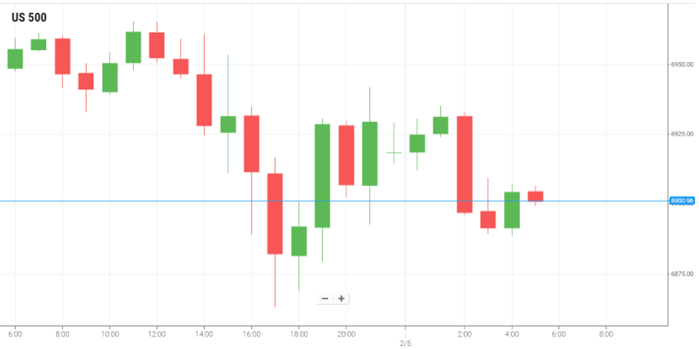
US stocks finished mostly lower on Wednesday, though the major indices recovered from their session lows, as weakness in technology shares continued to pressure broader markets. A sharp post-earnings selloff in chipmaker Advanced Micro Devices weighed heavily on sentiment, while investors also digested softer US labor market data and positioned ahead of earnings from Alphabet. In contrast, the US 30 outperformed supported by strength in healthcare stocks.
Investor sentiment toward technology stocks has deteriorated in recent sessions amid concerns over intensifying competition from emerging artificial intelligence models. Market participants have rotated out of richly valued tech names, wary of the potential disruptive impact of AI on established software and analytics companies. The technology sector posted notable losses earlier in the week.
Investors are now turning their attention to earnings from Alphabet, due after the market close. Much of the focus is expected to center on the Google parent’s aggressive investment plans in artificial intelligence, including multibillion-dollar spending on data centers and advanced chips.
On the macroeconomic front, data showed US private-sector job growth slowed more than expected in January. The ADP National Employment Report indicated that private payrolls increased by 22,000 jobs last month, down from a downwardly revised 37,000 gain in December and well below expectations for a 50,000 increase.
The figures come amid a brief US government shutdown, which delayed the release of the closely watched monthly nonfarm payrolls report, making the ADP data one of the few available indicators of January labor market conditions.
Meanwhile, activity in the US services sector remained resilient. The Institute for Supply Management’s Services Purchasing Managers’ Index held steady at 53.8 in January, above consensus forecasts and signaling continued expansion in a sector that accounts for more than two-thirds of US economic output.
The materials contained on this document should not in any way be construed, either explicitly or implicitly, directly or indirectly, as investment advice, recommendation or suggestion of an investment strategy with respect to a financial instrument, in any manner whatsoever. Any indication of past performance or simulated past performance included in this document is not a reliable indicator of future results. For the full disclaimer click here.
 Trusted partner
 Featured partner
 By
By 


