
Listed on 
 Years active
 English
  Dutch - Nederlands
 French - Français
 German - Deutsch
 Greek - Ελληνικά
 Hungarian - Magyar
 Italian - Italiano
 Polish - Polski
 Spanish - Español

Get in touch
- Home
- Getting Started
- Blog
Years activeGet in touch
iFOREX Europe uses cookies to improve your browsing experience, personalize ads, analyze traffic, and ensure security. For more information, please visit our Cookie Policy or go to Manage preferences.
 23/06/2026 - 06:41 UTC
Financial markets experienced a volatile start to the week as major geopolitical breakthroughs clashed with shifting central bank expectations. The primary catalyst was the unexpected diplomatic progress between the US and Iran during talks in Switzerland, where mediators established a 60-day roadmap toward a comprehensive peace deal and Iran agreed to readmit international nuclear inspectors. In response, the US Treasury temporarily eased sanctions on Iranian crude exports. This sudden reduction in geopolitical friction fundamentally reshaped the trading landscape, sending shockwaves through energy markets while forcing macro traders to weigh easing inflation risks against a hawkish domestic policy backdrop.
Crude oil bore the brunt of this diplomatic thaw on Monday, with West Texas Intermediate (WTI) plummeting 4.52% as the easing of US sanctions sparked immediate fears of a global supply influx. This sell-off dragged WTI down toward a multi-month trough near $74.00. Conversely, safe-haven gold defied the broader "risk-on" mood to gain 1.14% on Monday, steadying near the $4,190–$4,200 range. Analysts noted that violent swings in energy prices ultimately acted as a primary short-term driver for precious metals, keeping gold well-supported despite the easing of geopolitical tensions.
Meanwhile, the US Dollar Index (USDX) edged up 0.12% on Monday, hovering just below its 13-month high of 101.13. While the optimistic headlines from Switzerland initially dampened safe-haven demand for the Greenback, the currency found a powerful floor in tightening domestic monetary policy. Investors continued to digest a surprisingly hawkish stance from the newly appointed Federal Reserve Chair, Kevin Warsh, whose aggressive tone on inflation prompted futures traders to price in an 89% chance of a December rate hike. This persistent yield advantage successfully insulated the dollar from any deeper geopolitical sell-offs, keeping it firmly anchored at the top of its recent range.
An artificial intelligence-driven profit-taking wave swept through global markets during the latest trading session, triggering a sharp reversal in technology benchmarks after weeks of massive, AI-fueled gains. As sentiment cooled overnight, investors locked in profits on premier hardware and semiconductor leaders. This selling pressure was highly visible across major global tech heavyweights, with market bellwether Nvidia dropping 0.85% as Wall Street's technology momentum paused.
The retreat in U.S. tech sectors sent immediate shockwaves into Asian markets, heavily impacting the region's top-tier supply chains. South Korean hardware giants bore the heaviest losses of the session; Samsung Electronics tumbled 5.10% and AI-memory specialist SK Hynix plunged 5.81%. This broad cooling of enthusiasm came as macroeconomic factors—including a hawkish Federal Reserve outlook and a temporary easing of Middle East geopolitical tensions—prompted a widespread reassessment of stretched valuations across the entire artificial intelligence ecosystem.
Wall Street delivered a mixed performance on Monday, heavily constrained by a steep rotation out of major technology and communication names. The primary drag on the market was a 5.07% decline in Alphabet, which anchored the stock among the top percentage losers on both the S&P 500 and the Nasdaq Composite. This sharp pullback erased billions in market value and dragged the broader S&P 500 Communication Services sector down by nearly 4%. Investor anxiety around the Google parent amplified following the sudden departures of two high-profile artificial intelligence executives in a span of just a few days, compounding broader market worries regarding AI infrastructure costs and intensifying industry competition.
The souring tech sentiment extended to the broader private markets, where SpaceX slumped 16.5% on Monday. The drop marked a third consecutive daily decline for the aerospace giant following its historic public debut on June 12, cooling off after a massive initial rally that had briefly pushed its market valuation past corporate titans like Microsoft and Amazon.
Moving forward, market participants are shifting their focus toward a highly anticipated cross-section of corporate earnings and critical macroeconomic data to judge if the market's recent upward momentum is sustainable. On the corporate front, a packed calendar features imminent results from FedEx and Carnival Corporation, followed closely by a crucial chip-sector update from Micron Technology. Simultaneously, investors are preparing for the final Q1 Gross Domestic Product (GDP) reading and the Core Personal Consumption Expenditures (PCE) Price Index. This key inflation metric will be heavily scrutinized to gauge the future trajectory of monetary policy under Federal Reserve Chair Kevin Warsh.
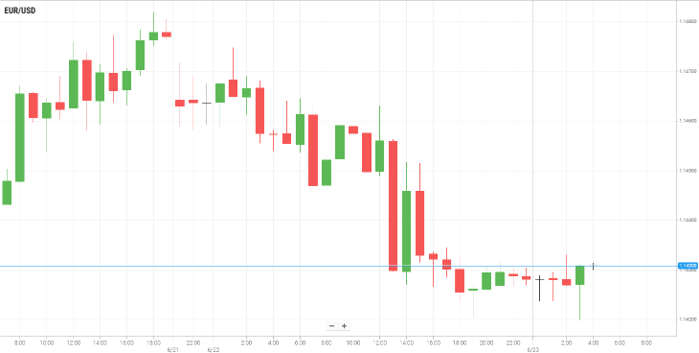
The euro remained largely unchanged early on Tuesday as traders adopted a cautious stance while monitoring the latest developments in the ongoing diplomatic discussions between the United States and Iran.
The EUR/USD pair stabilized after posting modest losses in the previous session, trading near 1.1430 during Asian trading hours. The currency pair continued to move within a narrow range as investors assessed progress in negotiations between Washington and Tehran, which are taking place in Bürgenstock, Switzerland.
Optimism surrounding the talks increased after US Vice President JD Vance said negotiations had achieved “great progress,” although he acknowledged that some areas of disagreement remain. Earlier, Vance revealed that Iran had agreed to allow the return of International Atomic Energy Agency (IAEA) inspectors. Iranian Foreign Minister Abbas Araghchi also expressed confidence, describing the discussions as having delivered “major progress.”
Meanwhile, the US dollar continued to receive support from expectations of a more hawkish Federal Reserve policy stance. The Fed recently kept its benchmark interest rate unchanged at 3.50%-3.75%, but updated economic forecasts and comments from Fed Chair Kevin Warsh, during his first policy meeting in the role, were viewed as more aggressive than markets had expected.
The euro, meanwhile, faces a more cautious outlook after comments from European Central Bank President Christine Lagarde. While she acknowledged that the current inflation shock is “too large to ignore,” Lagarde said there were no signs of unanchored inflation expectations or damaging second-round effects that could threaten the ECB’s inflation objectives.
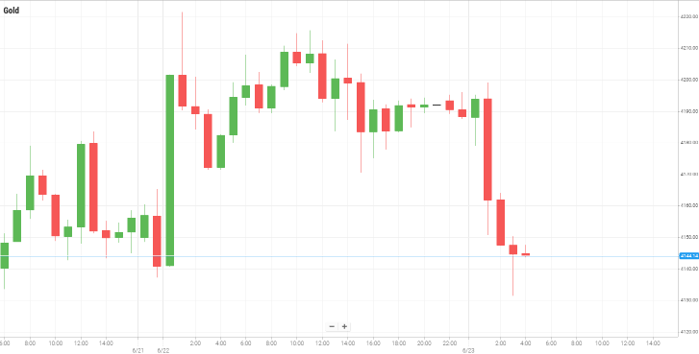
Gold came under renewed selling pressure on Tuesday, falling back below the $4,150 level as a stronger US dollar and shifting expectations around Federal Reserve policy reduced demand for the precious metal.
The XAU/USD pair reversed much of the previous session’s gains during Asian trading hours as investors remained cautious despite signs of progress in US-Iran negotiations. The dollar maintained its recent strength, trading near a one-year high, supported by geopolitical uncertainty and the Fed’s increasingly hawkish stance.
Geopolitical risks remain elevated after US President Donald Trump emphasized that preventing Iran from developing nuclear weapons remains a priority despite potential economic costs. Meanwhile, Iran’s chief negotiator and parliamentary speaker Mohammad Bagher Ghalibaf stated that the Strait of Hormuz would remain under Tehran’s control, keeping concerns about regional stability alive and supporting demand for the US dollar as a safe-haven asset.
The gold market is also facing pressure from expectations of tighter Federal Reserve policy. The central bank indicated last week that further rate increases may be necessary if inflation remains persistent. Chicago Fed President Austan Goolsbee added that inflation trends were moving in the wrong direction and remained above the Fed’s 2% target.
Traders are now watching upcoming US economic releases, including flash Purchasing Managers’ Index (PMI) data and comments from Federal Open Market Committee (FOMC) officials, for further direction. Market attention will then turn toward Thursday’s US Personal Consumption Expenditures (PCE) inflation report and the final first-quarter GDP reading.
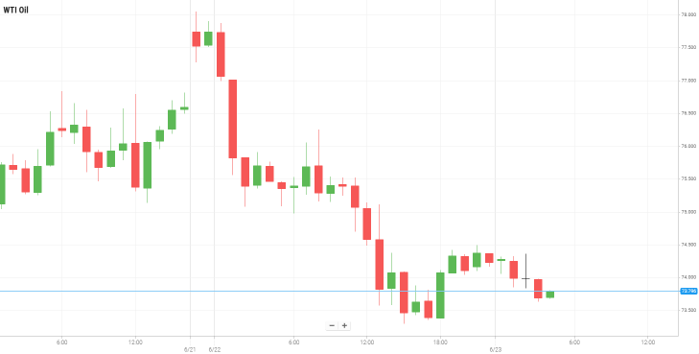
Oil prices continued to decline on Tuesday, extending losses from the previous session as investors awaited clearer evidence of a sustained recovery in crude flows through the Strait of Hormuz following recent US-Iran peace discussions.
The decline followed a more than 3% drop on Monday after the United States granted Iran a 60-day sanctions waiver following initial diplomatic talks. Market sentiment also improved after reports indicated a reduction in hostilities in Lebanon as part of broader regional de-escalation efforts.
Ship-tracking data showed that two crude tankers carrying nearly 2 million barrels of oil passed through the strategic waterway on Monday, signaling that traffic was beginning to recover after weaker flows over the weekend due to safety concerns.
Analysts said increased tanker movements are being closely monitored as a potential indicator of both physical oil supply recovery and progress in diplomatic negotiations. However, uncertainty remains, leaving markets caught between optimism over potential peace developments and concerns over unresolved geopolitical risks.
Meanwhile, attention is also turning toward US inventory data. A Reuters poll suggested that US crude stocks likely declined last week, along with gasoline and distillate inventories, reflecting tighter supply conditions.
Recent government data showed that crude held in the US Strategic Petroleum Reserve dropped to 331.2 million barrels last week, marking the lowest level since June 1983. The decline came as energy markets adjusted to supply disruptions linked to the US-Iran conflict.
Going forward, oil prices are expected to remain highly sensitive to developments surrounding the Strait of Hormuz, diplomatic progress between the US and Iran, and upcoming US inventory reports. Any further improvement in shipping activity could continue to pressure prices, while renewed geopolitical tensions may provide support.
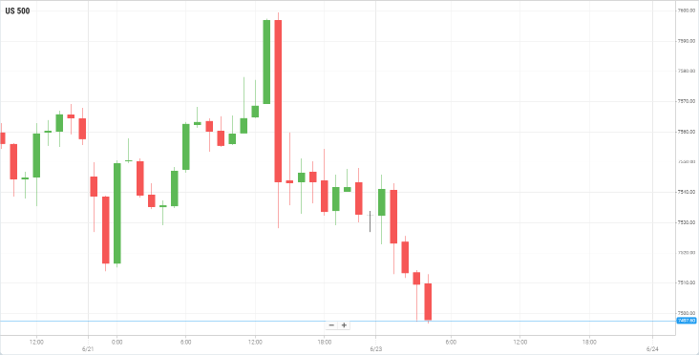
US stock markets closed mixed on Monday as a sharp decline in Alphabet shares weighed on the technology and communication services sectors, while investors continued to assess developments in the Middle East and the potential impact of US-Iran diplomatic progress.
The communication services sector was the weakest performer among the 11 major S&P 500 sectors, pressured by losses in Alphabet. Meanwhile, real estate, energy, and healthcare were among the strongest-performing sectors.
Investor attention is now shifting toward upcoming US economic data, including purchasing managers’ index readings and revised first-quarter GDP figures.
The Federal Reserve’s recent policy signals remain a key market driver after its updated economic projections showed stronger support for potential interest rate increases if inflation remains elevated. Rising oil prices linked to geopolitical tensions have added to concerns about inflation pressures, reinforcing expectations for a more restrictive monetary policy stance.
Alphabet shares fell 5% on Monday, making the company one of the biggest decliners on both the US 500 and US Tech 100. The decline came after the company lost two senior artificial intelligence executives within a short period.The departures raised concerns about competition in the artificial intelligence sector, particularly as rivals continue to expand their AI capabilities.
Meanwhile, SpaceX shares extended their recent decline, falling 16.54% and marking a third consecutive day of losses following the company’s market debut earlier in the month. Despite previously achieving a significant valuation surge, the stock has faced pressure as investors reassess its growth outlook.
The materials contained on this document should not in any way be construed, either explicitly or implicitly, directly or indirectly, as investment advice, recommendation or suggestion of an investment strategy with respect to a financial instrument, in any manner whatsoever. Any indication of past performance or simulated past performance included in this document is not a reliable indicator of future results. For the full disclaimer click here.
 Trusted partner
 Featured partner
 By
By 


