










CFDs are complex instruments and come with a high risk of losing money rapidly due to leverage. 80% of retail investor accounts lose money when trading CFDs with this provider.
You should consider whether you understand how CFDs work and whether you can afford to take the high risk of losing your money. Read More
Take advantage of index trading in the form of CFDs

| Instrument | Buy | Sell | High (Sell) | Low (Buy) |
|---|---|---|---|---|
| Loading… | ||||
When trading indices as CFDs:
However, leverage also increases the risk by the same volume. As such, it’s best to put limits on certain trades as you have a budget for and to be updated on economic news like on the iFOREX Europe economic calendar.
Most traded indices among active traders
Certain global indices consistently attract strong trading interest due to their liquidity, visibility, and responsiveness to economic developments:
S&P 500 (US 500)
Represents 500 major U.S. corporations across multiple sectors. It is widely followed and often reacts to corporate earnings, inflation data, and U.S. Federal Reserve decisions.
NASDAQ 100
Heavily weighted toward technology and growth-oriented companies. This index is typically more volatile and sensitive to innovation trends, investor sentiment, and shifts in interest rate expectations.
DAX 40 (Germany)
A key benchmark for the German economy and broader European market sentiment. It is influenced by ECB policy decisions, manufacturing data, and international trade developments.
FTSE 100 (UK)
Composed largely of multinational firms with significant global exposure. Movements in commodities, currency fluctuations, and global economic conditions often impact this index.
These indices are commonly traded because they offer strong liquidity, transparent pricing, and recurring price activity, making them suitable for structured CFD strategies supported by defined risk-management tools.
Step 1: Open an iFOREX Europe Account
Step 2: Make a deposit or start with a demo
Step 3: Choose an index CFD
Step 4: Decide to Buy (rise) or Sell (fall)
Step 5: Set stop-loss and take-profit levels
A broker operating under recognised regulatory frameworks offers clearer rules, higher transparency, and stronger safeguards for client funds. Regulation helps ensure fair execution and responsible trading conditions.
Index trading is often active and time-sensitive. Competitive spreads and clear pricing are key, especially for traders who open and close positions frequently.
Stock indices react to economic data, central bank policy, and global risk sentiment. A strong trading environment should include charts, indicators, signals, and macroeconomic insights.
Index markets can move quickly. When conditions change, having access to knowledgeable, real people — not automated replies — can make a meaningful difference.
Effective trading requires discipline. Tools such as stop-loss orders, margin monitoring, and alerts help traders keep exposure aligned with their strategy.
Trading indices as CFDs follows a straightforward and transparent pricing structure:

The spread represents the cost of entering a trade. Tighter spreads are particularly important for short-term and intraday index strategies.

Positions held beyond the trading day may be subject to a financing adjustment, reflecting the cost of maintaining leveraged exposure.

Index CFD trades on the iFOREX Europe platform do not carry additional commission charges.
Indices reflect the performance of entire markets or sectors, reducing reliance on the movement of a single company.
CFDs allow traders to take positions in rising or falling markets, depending on their outlook.
Major indices tend to be most active during London and New York trading hours, offering consistent price movement.
Position sizes can be adjusted to suit different strategies and risk profiles, while leverage increases market exposure (and risk).
Both profits and losses are amplified, making careful position sizing essential.
Interest rate decisions, inflation data, earnings seasons, and geopolitical developments can drive sharp price movements.
Trading multiple indices without understanding how they move in relation to each other can increase overall exposure.
Keeping positions open overnight may result in financing charges, particularly for longer-term trades.

Get assistance from dedicated representatives, available in your language.

Learning resources and guidance support both new and experienced traders.

Advanced charts, signals, sentiment indicators, and macro insights are built into the platform.
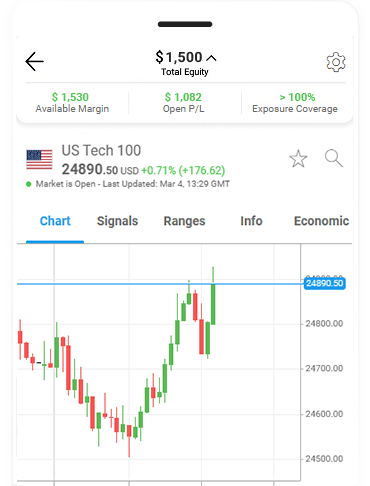
A stock index reflects the performance of a selected group of companies representing a specific market or sector. It provides a snapshot of overall market direction rather than the movement of a single company.
Yes. Through CFDs, you can speculate on the price movements of an index without owning the underlying shares that make up that index.
Yes. Index CFDs allow you to open Buy (long) positions if you expect prices to rise, or Sell (short) positions if you anticipate a decline.
Index prices are driven by macroeconomic indicators such as interest rates and inflation, corporate earnings results, economic growth data, central bank decisions, and geopolitical developments.
Indices may be suitable for some traders because they provide exposure to broader markets. However, it is important to combine trading with education, practice in a demo environment, and proper risk-management techniques.
Yes. Index markets can experience significant volatility, and the use of leverage increases both potential gains and potential losses. Careful risk management is essential.
iFOREX Europe offers access to major global index CFDs within a regulated European framework, supported by analytical tools, educational resources, and multilingual human assistance.